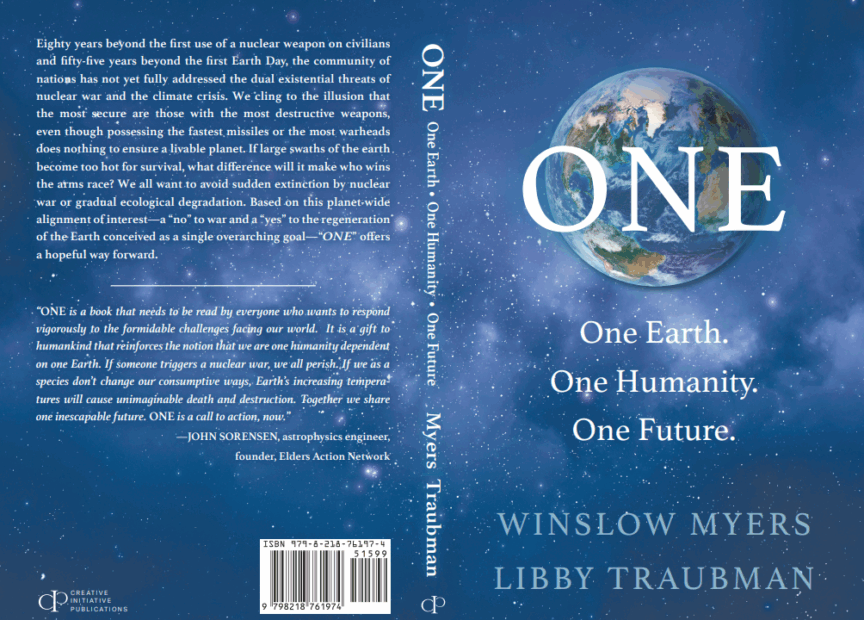
You can order your copy of ONE from:
Amazon, Barnes & Noble, Bookshop.org, Books-A-Million, and bookstores worldwide.
Eighty years beyond the first use of a nuclear weapon on civilians and fifty-five years beyond the first Earth Day, the community of nations has not yet fully addressed the dual existential threats of nuclear war and the climate crisis. We cling to the illusion that the most secure are those with the most destructive weapons, even though possessing the fastest missiles or the most warheads does nothing to ensure a livable planet. If large swaths of the earth become too hot for survival, what difference will it make who wins the arms race? We all want to avoid sudden extinction by nuclear war or gradual ecological degradation.
Based on this planet-wide alignment of interest—a “no” to war and a “yes” to the regeneration of the Earth conceived as a single overarching goal—ONE offers a hopeful way forward.
This brief overview highlights key ideas from One. It is intended to introduce the book as a catalyst for discussion among peace and climate groups, students, academic courses, community organizations, and others seeking constructive responses to today’s global challenges.
1. A Shift in the Way We Think
Humanity has entered a new phase of history. The continuing threat of nuclear war, accelerating climate disruption, population pressures, and the peril (and possible promise) of artificial intelligence together reveal a profound change in our planetary reality.
These challenges require more than technical solutions. They require a shift in awareness: a lived understanding that what any one of us does—or fails to do—affects everyone else, and that the actions of others affect us in return.
We are all, quite literally, in the same leaky boat.
This growing awareness of interdependence presents an extraordinary opportunity. Humanity now shares a practical common interest in survival and flourishing. Yet if we continue to minimize or postpone responding to these realities, the window for constructive change may narrow within a few short decades.
The major global crises are deeply interconnected. Consider the relationship between militarism and climate disruption. Nuclear-armed nations measure security largely by weapons stockpiles, yet nuclear weapons cannot provide drinkable water, stabilize food systems, or power cooling systems in extreme heat. Scientific talent and material resources devoted to preparing for war are diverted from addressing climate instability and its consequences, including mass displacement and migration.
2. Between Old Assumptions and Emerging Possibilities
As humanity begins to move toward models of shared security, resilience, and cooperation—rather than relentless military and economic competition—every major institution will evolve: political, economic, educational, religious, and military.
We are already witnessing such transitions. The rapid global expansion of renewable energy increasingly makes fossil fuels appear as the true “alternative energy.”At the same time, powerful inherited assumptions slow necessary change.
Nuclear deterrence rests on the belief that perpetual competition can indefinitely prevent catastrophe: we build, they build. Weapons must remain permanently ready for instant use in order never to be used. History shows how fragile this logic is, as during the near catastrophe of the 1962 Cuban Missile Crisis. A security protocol that allows leaders only minutes to decide the fate of civilization is, at best, dangerously flawed.
Similarly, prevailing economic systems often measure success without adequately accounting for ecological health. When short-term profit outweighs clean air, stable oceans, or predictable agriculture, economic logic ultimately produces the same closed future promised by nuclear escalation.
Nations acting from “us-versus-them” thinking assume they can violate international norms without consequence. Yet in an interdependent world shaped by climate risk and nuclear danger, domination of territory or resources increasingly becomes self-defeating.
What knowledge points beyond these impasses?
Every human being emerged from the same cosmic process that formed atoms, stars, planets, life, and consciousness. Our task is not to compete against that creative process but to cooperate with it—to steward the biosphere that sustains all life.
From the perspective of Earth seen from space, humanity has no permanent enemies—only fellow humans who seek safety and dignity for their children, just as we do. “An enemy is a stranger whose story we have not heard.
3. The Personal Gymnasium
Changes in thinking can spread rapidly in a connected world, but transformation still occurs person by person. As Gandhi suggested, we must become the change we hope to see. Structural transformation cannot occur without personal example. This does not require perfection, only commitment to constructive action.
Conflict—whether personal or international—can move toward nonviolent resolution when participants ask a different question: What outcome benefits the whole?
Blame consumes energy needed for solutions. Progress depends instead on strengthened capacities for listening, curiosity, and mutual respect. Each of us holds only a partial view of truth; shared understanding emerges through dialogue and working together toward shared goals.
Developing these capacities becomes a demanding personal practice—a lifelong workout. Meeting planetary challenges requires nothing less.
4. How Change Happens
Facing widespread suffering and chaos, it is natural to doubt whether positive change is possible. Yet history demonstrates the remarkable adaptability and creativity of our species.
Our present task is fundamentally educational. New ways of thinking have repeatedly reshaped what once seemed permanent: slavery became illegal; democratic participation expanded; European nations formed cooperative institutions after devastating wars; nonviolent movements led by figures such as Gandhi and Martin Luther King Jr. transformed political reality.Social change typically unfolds slowly at first. New ideas emerge among a few visionaries, spread to opinion leaders, and eventually become common sense.
Large systems tend to change when three forces converge:
1. Material pressure — climate disruption, economic risk, or near-catastrophe
2. Elite doubt — declining confidence in existing policies
2. Moral imagination — availability of a new framework
Activists often cultivate the third long before the first two mature. Much work may therefore feel ineffective—until suddenly it becomes indispensable.
“Live the questions.” — Rainer Maria Rilke
Questions for Dialogue
• What makes this historical moment unique in Earth’s story?
• What might it mean to say that war has become obsolete?
• How have nuclear weapons and environmental disruption reshaped the meaning of security?
• In what ways are climate and nuclear risks connected?
• Why is addressing our personal and collective “shadow side” important?
• What evidence suggests life on Earth is fundamentally interconnected?
• Recall a conflict that was resolved in your life. What made resolution possible?
• When have you acted without complete certainty? What enabled you to proceed?
• What change in shared assumptions could make war less likely?
• What qualities define effective leadership today?
• Where is your own “workout” in this personal gymnasium?
• What habits of thought or action feel ready for strengthening?
Beginning Where We Are
Interdependence operates at every scale. Small actions ripple outward in ways we cannot fully trace. Friendly conversation with a stranger, support for a neighbor, or participation in community dialogue may indirectly strengthen conditions for global peace. We begin with the capacities we already possess. No constructive action is too small to matter. Feeding the hungry, reducing isolation, engaging respectfully across differences—each strengthens both society and ourselves. Education, dialogue, and expanded understanding remain among the most powerful forms of action available to ordinary citizens.
Organizations to Explore
Multiply your effectiveness by working with others
• Third Act — thirdact.org. Americans over sixty mobilizing to protect climate and democracy.
• World BEYOND War — worldbeyondwar.org. A global movement working to end war.
• Elders Action Network — eldersaction.org. Elders acting for future generations and all life.
• Euphrates Institute — euphrates.org. Global citizens practicing peace personally and collectively
Additional Ways to Act• Write letters to media outlets and elected officials.
• Ask thoughtful questions of political candidates.
• Reduce reliance on fossil fuels:
•Install electric appliances or heat pumps
•Consider electric or hybrid vehicles
•Join community solar programs
Albert Einstein observed that today’s problems cannot be solved by the same level of thinking that created them. A mode of thinking is a framework shaping what we notice, ignore, and imagine possible. Humanity now stands between obsolete assumptions and emerging possibilities. The practices explored here strengthen capacities we already possess—empathy, cooperation, courage, and care for the whole. Each act of practice contributes to a collective readiness equal to this unique moment in human history.
Winslow Myers Author page on Amazon: https://www.amazon.com/stores/Winslow-Myers/author/B0FVNJSJ96